
Maa Brahmacharini Mantra, Katha, Aarti and Bhog: Navratri Day 2 Puja Vidhi
Who Maa Brahmacharini is, the meaning of Dwitiyam Brahmacharini, her mantras with meaning, her katha as Aparna, the Day 2 puja vidhi, bhog, colour and aarti.
Who is Maa Brahmacharini? (Brahmacharini Devi Meaning & Form)
"Brahmacharini" combines brahma, meaning penance or the pursuit of truth, and charini, one who practises or walks that path. She is the second of the Navdurga, worshipped on Day 2 as the form of the Devi devoted entirely to tapasya (austerity).
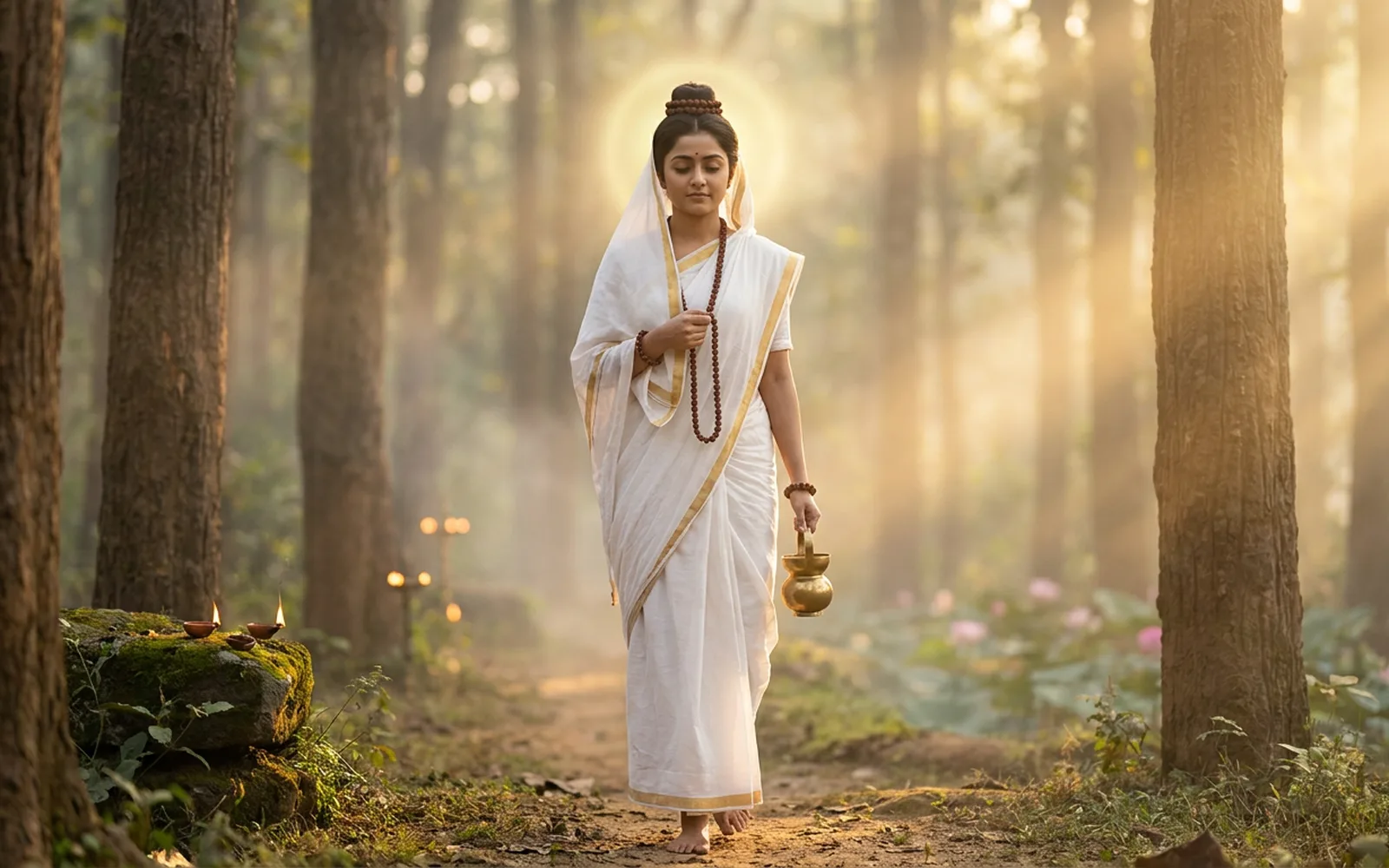
She's shown walking barefoot, dressed in white, holding a japa mala (rosary) in her right hand and a kamandalu (water pot) in her left. The rosary stands for constant meditation, the kamandalu for simplicity and detachment, and her bare feet for humility.
Pratham Shailputri, Dwitiya Brahmacharini: Which Devi on Day 2?
प्रथमं शैलपुत्री च द्वितीयं ब्रह्मचारिणी।
Pratham Shailputri Cha, Dwitiyam Brahmacharini
"First is Shailputri, second is Brahmacharini."
This is the second line of the Navdurga shloka, the Sanskrit verse that names all nine forms of Durga in the order they're worshipped. Dwitiya means second, and it's why Maa Brahmacharini's day falls right after Shailputri's.
Learn more: what connects Day 1 and Day 2?
Shailputri and Brahmacharini are really two chapters of the same story. Shailputri is Parvati newly born as the mountain king's daughter; Brahmacharini is the same Parvati years later, undertaking the penance that would eventually win her Shiva as her husband.
Maa Brahmacharini Mantra & Beej Mantra (with Meaning)
Brahmacharini mata mantra:
ॐ देवी ब्रह्मचारिण्यै नमः॥
Om Devi Brahmacharinyai Namah
"Salutations to Goddess Brahmacharini."
Suitable for daily puja and jaap.
Beej (seed) mantra, used in havan:
ॐ ऐं नमः स्वाहा॥
Om Aim Namah Swaha
This compact beej mantra invokes Saraswati's seed syllable "aim," tied to Brahmacharini's association with knowledge and the pursuit of truth.
Dhyana mantra, describing her form:
दधाना करपद्माभ्यामक्षमालाकमण्डलू। देवी प्रसीदतु मयि ब्रह्मचारिण्यनुत्तमा॥
Dadhana Kara Padmabhyam Akshamala Kamandalu, Devi Prasidatu Mayi Brahmacharinyanuttama
"O Goddess Brahmacharini, who holds the rosary and water pot in her lotus hands, be gracious to me."
Brahmacharini Mata ki Katha
As Parvati, daughter of Himavan, the young Devi had one resolve: to marry Lord Shiva, her husband from her earlier life as Sati. On the advice of Sage Narada, she understood this could only happen through severe tapasya, and she left the comforts of her father's home for the forest.
Her penance was extreme even by the standards of sages. She lived first on fruit, then only on dry bilva leaves, and eventually gave up even that, earning her the name Aparna, "one without leaves." She stood through searing heat, pouring rain and bitter cold, her mind fixed entirely on Shiva, who remained deep in meditation, undisturbed by the world.
Shiva himself, moved by her resolve, once appeared before her disguised as a wandering ascetic and tried to dissuade her, listing all the reasons she shouldn't want him as a husband. Parvati refused to waver. Pleased beyond measure by a devotion that could not be shaken, Shiva finally revealed his true form and accepted her.
This fierce, unwavering phase of Parvati's life, before she won Shiva, is what Navratri honours on Day 2 as Maa Brahmacharini.
Maa Brahmacharini Puja Vidhi on Navratri Day 2
- Continue the daily puja. Keep the kalash and barley watered, as established on Day 1.
- Place her image or idol. Set Maa Brahmacharini's photo, ideally dressed in white, near the kalash.
- Offer the dhyana mantra. Recite "Dadhana Kara Padmabhyam..." while visualising her in meditation, rosary in hand.
- Chant her mantra. Say "Om Devi Brahmacharinyai Namah" with flowers and a lit diya.
- Offer sugar or mishri. This is her traditional bhog, offered simply.
- Close with the aarti. End with the Devi aarti, given below.
This is the structure followed in the Hinglaj Mata Manokamna Siddhi Paath with Navgrah Havan at Pushkar, performed by temple Pandits on Day 2 for those who'd like the worship done at a temple.
 Day 2 · Hinglaj Mata, PushkarNavratri Hinglaj Shaktipeeth Manokamna Siddhi Paath with Navgrah HavanManokamna Siddhi Paath with Navgrah Havan, performed by temple Pandits in your name.Hinglaj Mata Mandir, PushkarBook this puja
Maa Brahmacharini Bhog & Colour
Sugar or mishri is offered to Maa Brahmacharini on Day 2, with prayers for a long, peaceful life, matching the simplicity of her own ascetic days. The colour for her day is white, chosen for the purity and renunciation at the heart of her story.
She's also said to be fond of jasmine (chameli) and hibiscus flowers, which make a fitting offering alongside the bhog.
Brahmacharini Mata ki Aarti
As with Shailputri on Day 1, there's no aarti written specifically for Brahmacharini. The same Durga aarti, Jai Ambe Gauri, is sung for her and for every devi across all nine days of Navratri:
जय अम्बे गौरी, मैया जय श्यामा गौरी। तुमको निशिदिन ध्यावत, हरि ब्रह्मा शिवरी॥
Jai Ambe Gauri, Maiya Jai Shyama Gauri, Tumko Nishidin Dhyavat, Hari Brahma Shivari.
"Victory to Mother Gauri, who is meditated upon day and night by Hari, Brahma and Shiva."
The full aarti continues for several more verses and is sung after the evening puja each day.
Benefits of Worshipping Brahmacharini Devi
- Discipline and focus. Her tapasya is held up as the model for sustained effort toward a goal, whatever form that goal takes.
- Governs the Swadhisthana chakra. In yogic tradition, she's linked to the sacral chakra, associated with creativity and emotional balance.
- Patience through hardship. Devotees pray to her for the resolve to keep going through a difficult period without giving up.
- Strength to fast with intention. Many begin the stricter days of their Navratri vrat from Day 2 onward, drawing on her example of austerity.
Book a Navratri puja at a Devi temple
Navratri Hinglaj Shaktipeeth Manokamna Siddhi Paath with Navgrah HavanPushkar · Navgrah Havan Navratri Pratham Shaktipeetham Maa Shailputri 11,001 Beej Mantra Havan & Panchopchar PujanHaridwar · Shailputri beej mantra havan
 Navratri Maa Tulja Bhavani Shakti-Vaibhav 108 Bhavani Ashtakam PaathKashi · Durga Saptashati path
 Navratri Raj Rajeshwari Hridaya Shanti Prem-Saubhagya Lalita Trishati AnushthanNaimisharanya · Lalita Trishati
 Navratri Maa Mahalakshmi Dhan-Sthirta Shri Nariyal Vidhi Solah Rajsi ShringarKashi · Mahalakshmi
 Navratri Navami 9 Devi Shakti Maha Havan with 9 Kanya PujanVaishno Devi · 9 Kanya Pujan
Pujas for you
Swipe · 12 pujas- Navratri Hinglaj Shaktipeeth Manokamna Siddhi Paath with Navgrah HavanHinglaj Mata Mandir, PushkarBook now
- Navratri Pratham Shaktipeetham Maa Shailputri 11,001 Beej Mantra Havan & Panchopchar PujanShree Adhisthatri Maya Devi Mandir, HaridwarBook now
- Navratri Maa Tulja Bhavani Shakti-Vaibhav 108 Bhavani Ashtakam PaathTulja Bhavani Durga Mata Mandir Rameshwar Rajatalab VaranasiBook now
- Navratri Raj Rajeshwari Hridaya Shanti Prem-Saubhagya Lalita Trishati AnushthanShri Lalita Devi Shakti Peeth, NaimisharanyaBook now
- Navratri Maa Mahalakshmi Dhan-Sthirta Shri Nariyal Vidhi Solah Rajsi ShringarShri Adi Mahalakshmi (Mahalakshmi Gauri) Mandir, VaranasiBook now
- Navratri Navami 9 Devi Shakti Maha Havan with 9 Kanya PujanNav Devi Mandir, Vaishno Devi Teerth KshetraBook now
 Navratri Akhand Deep & Shakti-Samriddhi-Vijay Maha HavanMaa Katyayani (Uma) Shaktipeeth, MathuraBook now
 Maa Tripura Sundari Shri Chakra Nivasini 11,000 Ahuti Maha HavanTripura Sundari Temple (Matabari), TripuraBook now
 Navratri Rare Temple Shree Yantra Abhishek – Apne Ghar Layen Ashirwadit Shree YantraShree Yantra Mandir, HaridwarBook now
 Kalighat Shaktipeeth Tantra Badha Nivaran Raksha Kavach Paath with 1,008 Ahuti HavanShakiteepth Kalighat, KolkataBook now
 Mahalakshmi Ambabai Rare Shaktipeeth Shodashopachar 4 Prahar Mahapuja (Get Dhanlakshmi Potli delivered after Puja)Shri Mahalaxmi Ambabai Temple, KolhapurBook now
 Navratri 9 Rashi 9 Devi 9 Grah Shakti Jagran MahahavanShri Mahalaxmi Ambabai Temple, KolhapurBook now
Frequently asked questions
- What does Brahmacharini mean?
- It combines "brahma" (penance, or the pursuit of truth) and "charini" (one who practises). She's the goddess who walks the path of tapasya.
- What is the Brahmacharini mata mantra?
- The most common mantra is "Om Devi Brahmacharinyai Namah," meaning "Salutations to Goddess Brahmacharini."
- What is the story of Maa Brahmacharini?
- As Parvati, she undertook severe penance to win Lord Shiva as her husband, giving up food and eventually even leaves, which earned her the name Aparna. Her devotion eventually won Shiva's acceptance.
- Why is Maa Brahmacharini worshipped on Day 2?
- She's the second of the nine Navdurga, following directly after Shailputri in the Navdurga shloka's order.
- What bhog is offered to Maa Brahmacharini?
- Sugar or mishri is her traditional bhog, reflecting the simplicity of her ascetic life.
- Which aarti is sung for Brahmacharini Devi?
- The same Durga aarti sung for every devi during Navratri, "Jai Ambe Gauri."
- Brahmacharini
- Maa Brahmacharini
- Navratri Day 2
- Navratri 2026
- Navdurga
- Mantra
- Aarti
Read next
All guides → NavratriShailputri Mata Mantra, Katha, Aarti and Bhog: Navratri Day 1 Puja VidhiWho Maa Shailputri is, the meaning of Prathamam Shailputri Cha, her mantras with meaning, her katha, the Day 1 puja vidhi, her bhog and colour, and the aarti.12 Oct 2026 · 5 min read
 0:59NavratriNavratri Bhog for 9 Days: Day-wise Bhog List for Each Devi (Navratri ke 9 Din ke Bhog)From ghee for Maa Shailputri to til for Maa Siddhidatri: the bhog for each of the nine days of Navratri 2026, what it means, and how to prepare it simply.9 Oct 2026 · 6 min read
 0:41NavratriNavratri Colours 2026: Nine Colours of Navratri Day-wise with Devi Names and SignificanceNine nights, nine forms of Maa Durga, nine colours to match. The 2026 day-wise list with dates, the devi of each day, what each colour means and saree ideas.9 Oct 2026 · 6 min read