
How to Perform Tarpan at Home: Step-by-Step Ritual Guide with Mantras and Samagri List
Most people skip Tarpan for fear of getting it wrong. The samagri you actually need, the seven steps in order, and the mantras written out in full.
Most people put off performing Tarpan themselves because they are afraid of getting it wrong — the wrong direction, the wrong hand position, a mantra mispronounced. That fear usually means the ritual simply never happens, and the guilt of skipping it lingers longer than the ten minutes the ritual itself would have taken. This guide breaks down the correct tarpan vidhi into clear steps, with the samagri you actually need and the mantras written out in full, so you can perform it at home with confidence.
- Time needed
- 10 minonce you know the steps
- Must have
- 2til and clean water
- Direction
- Southfor the Pitru portion
- Needs a pandit
- NoTarpan only — not Pind Daan
What Is Tarpan and Why Is It Important?
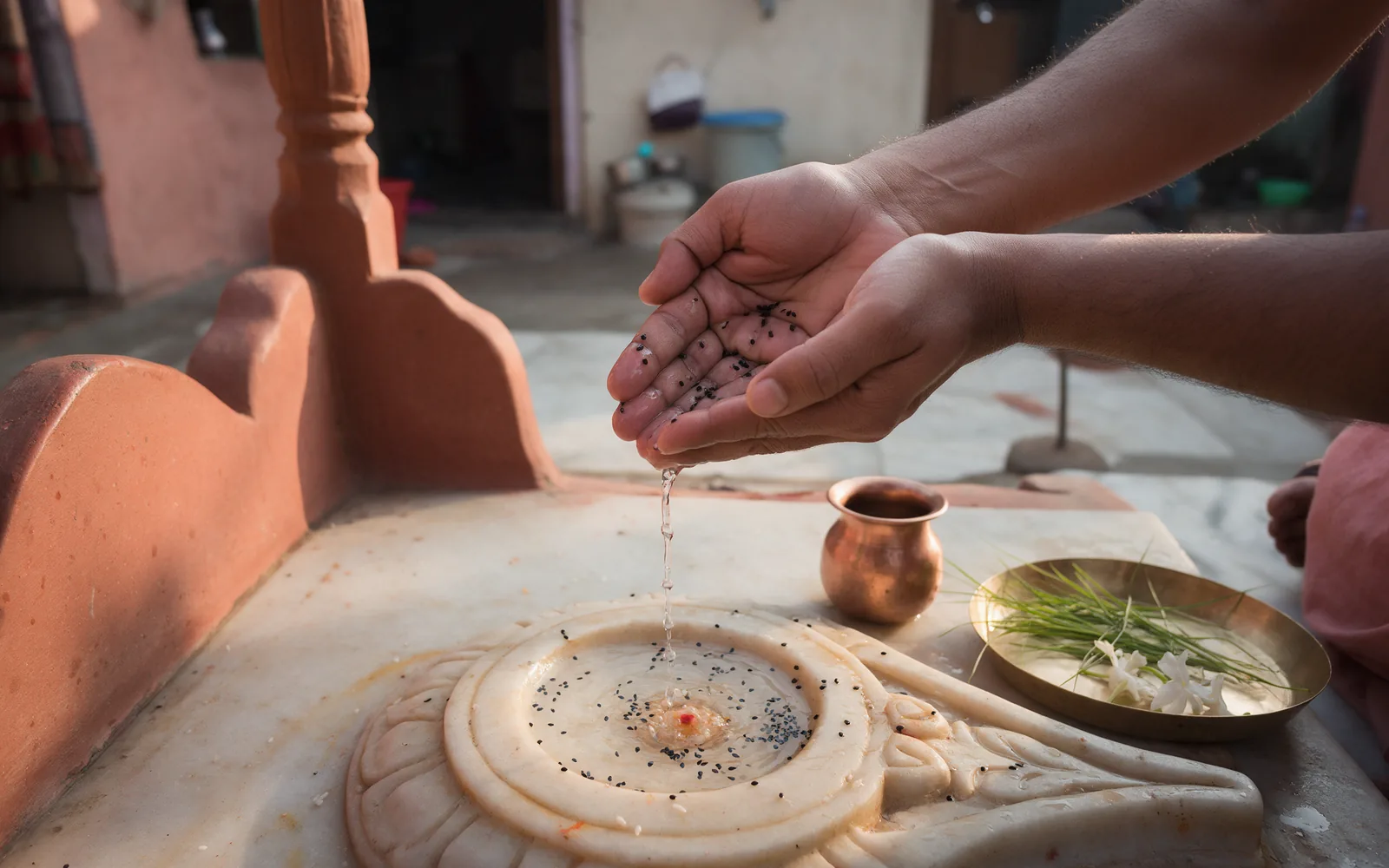
Tarpan is the offering of water, usually mixed with black sesame seeds, to one's ancestors. It is one part of a larger practice known as Shraddha karma, the broader set of rituals performed to honour and nourish departed ancestors. Where a full Shradh ceremony or Pind Daan typically needs a pandit, a sacred site and a specific tithi, Tarpan is the one part of this tradition that a householder can genuinely perform alone, at home, with a handful of simple materials.
This is why Tarpan is often the starting point for anyone learning how to do Pitru Paksha puja at home. It does not replace a full shradh puja or Pind Daan at a site like Gaya, but it is considered a meaningful, valid offering in its own right, especially when performed with sincerity and consistency.
What You'll Need: Complete Samagri List
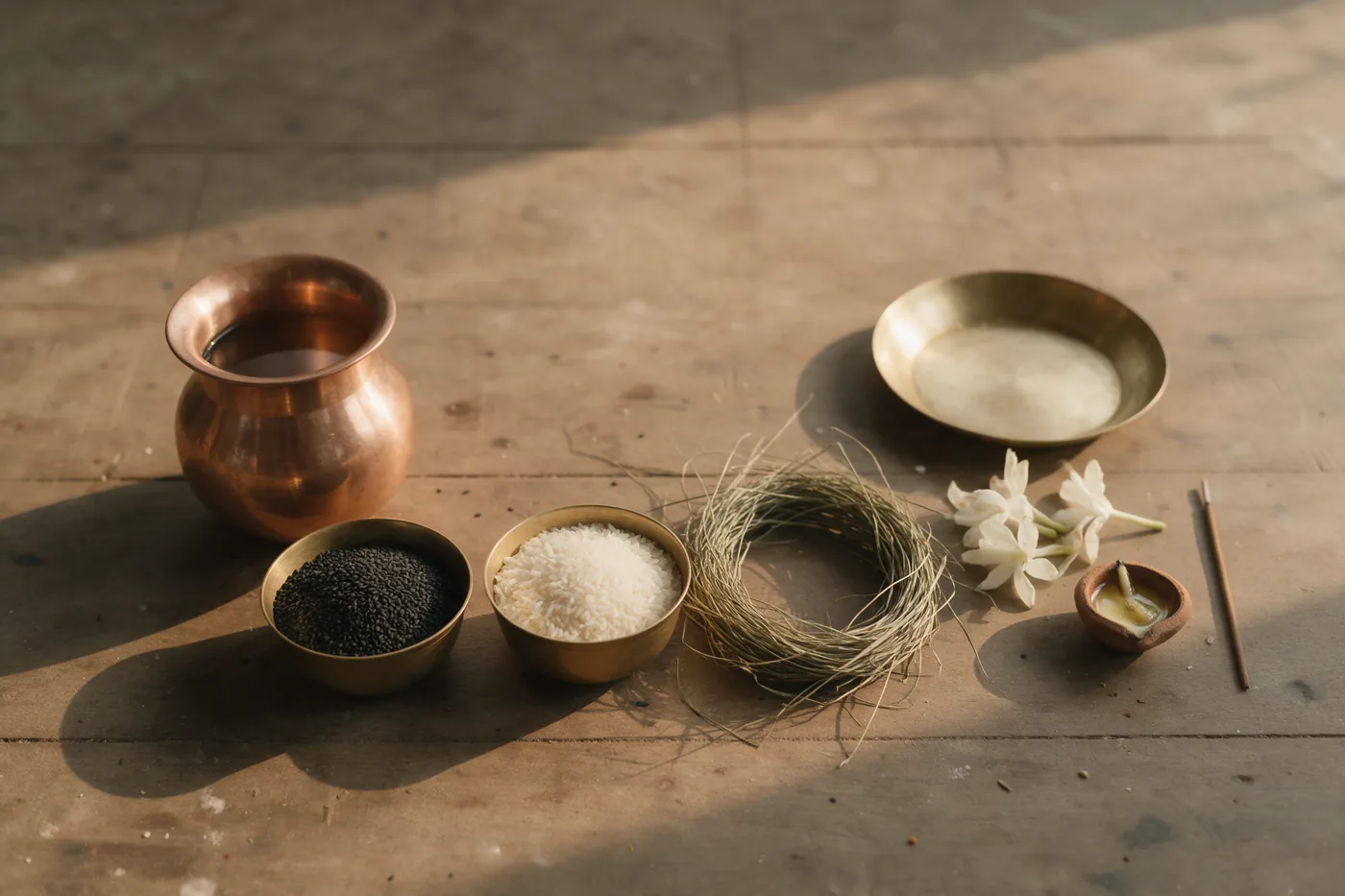
The samagri for a home tarpan vidhi is simple and easy to source. You will need:
- Black sesame seeds (til) — the single most important ingredient, believed to carry the offering to the ancestors
- Clean water, ideally with a few drops of Gangajal added if you have it, though plain water is acceptable
- A copper or brass vessel (lota) to hold the water
- Kusha or Darbha grass, used in many traditions as a ring (pavitri) worn on the ring finger, or as a seat
- A plate or wide, shallow vessel to receive the offered water, if you are not offering it directly onto soil or a plant
- White rice or barley (jau), optional, included in some regional traditions
- White flowers without strong fragrance, optional
- A small ghee lamp and incense, optional, for setting the space
Preparation Before the Ritual
A few things matter before you begin the actual offering.
Bathe and wear clean clothes. This is considered a basic requirement before any shradh puja at home, not just Tarpan specifically.
Choose a quiet, clean spot. Any clean corner of the home works — there is no requirement for a specific room or shrine.
Face south. South is traditionally considered the direction of the ancestors, and Pitru Tarpan is performed facing this direction. If you are also performing the preceding Deva and Rishi portions of a full tarpan — offerings to gods and sages, which precede the Pitru offering in the complete Vedic sequence — those are done facing east and north respectively. Only the ancestor-specific portion is done facing south.
Position the sacred thread, if you wear one. For those who wear a yagnopavita, it is repositioned over the right shoulder for the Pitru portion specifically, a position called apasavya. This detail only applies if you wear a sacred thread as part of your practice; it is not a requirement for performing Tarpan itself.
Take a short Sankalp. Before offering the water, state your name, your gotra if you know it, and your intention — for example, that you are performing this Tarpan for the peace of your ancestors, known and unknown, on both your paternal and maternal sides.
Learn more: what if you don't know your gotra?
If you do not know your gotra or the exact names of earlier generations, this is not a barrier.
Tradition holds that a sincere offering made in general remembrance, even without full names and lineage, is still accepted. A family pandit can confirm your gotra later if you want the fully personalised version of the mantra.
Step-by-Step Tarpan Procedure
- 1. Prepare the waterतिलोदक
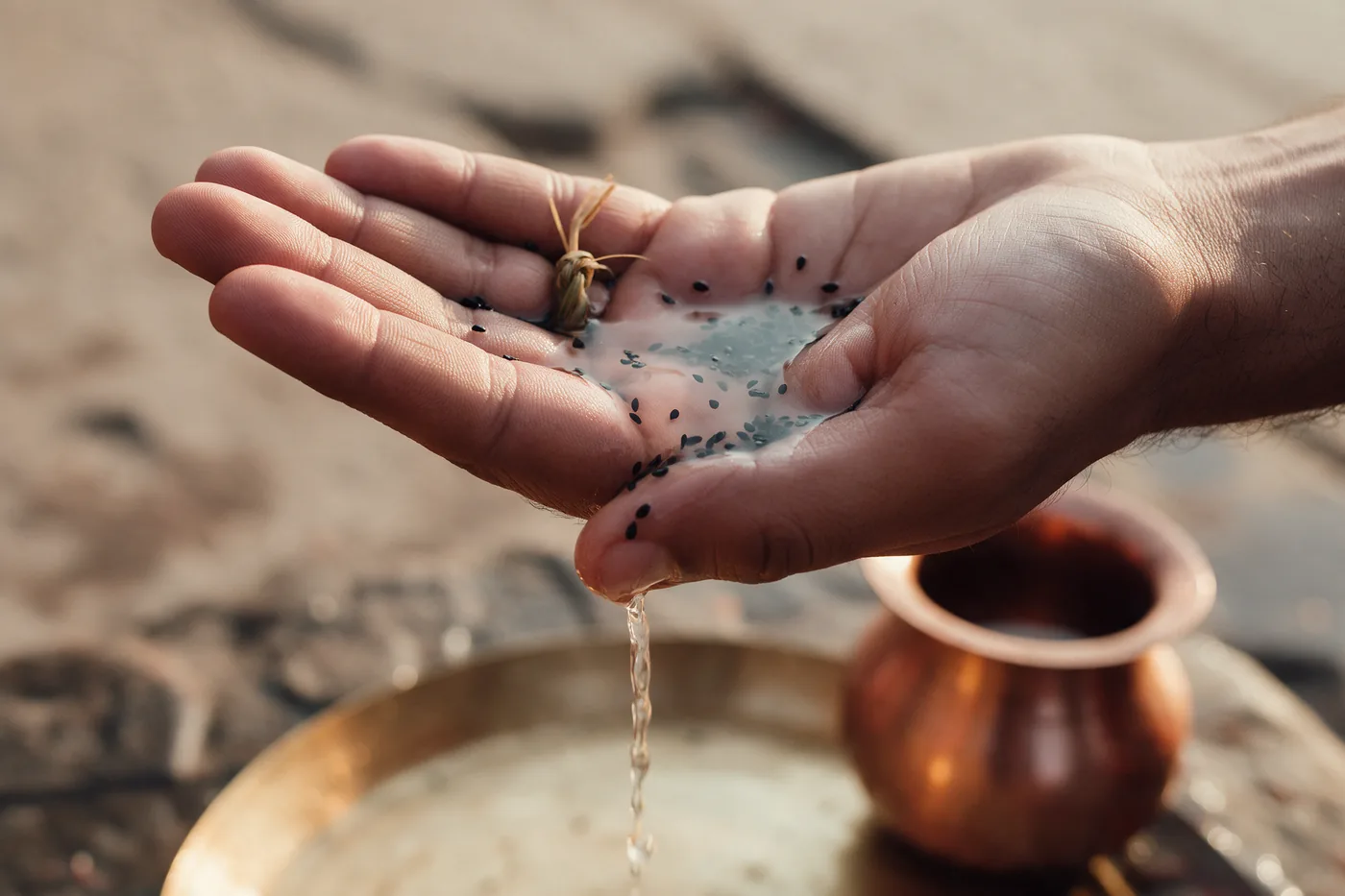
Mix black sesame seeds into the water in your copper vessel. Some traditions also add a pinch of rice or barley at this stage.
- 2. Take it in your palmsअंजलि
Cup both palms together, or hold the vessel in your right hand, and take a small amount of the sesame water.
- 3. Offer through the Pitru Tirthaपितृ तीर्थ
This is the step most people get wrong. The water should not simply run off your fingertips. For ancestor offerings specifically, it is released through the gap between your thumb and the base of your index finger, a point referred to as the Pitru Tirtha. Let the water flow through this gap slowly as you chant.
- 4. Chant the mantraपितृ मंत्र
While the water flows, chant the relevant tarpan mantra — the full wording is in the next section. Repeat the offering, generally three times per ancestor being named.
- 5. Repeat for each ancestorत्रिपुरुष
Traditionally this is done for three generations on the paternal side — father, grandfather, great-grandfather — and three on the maternal side, along with their respective wives where applicable. A simplified home version can focus on your own father and mother, and any grandparents you wish to specifically honour.
- 6. Concludeसमर्पण
Close with a general offering for all ancestors, known and unknown, followed by a final prayer or the Pitru Gayatri mantra.
- 7. Dispose of the water respectfullyविसर्जन
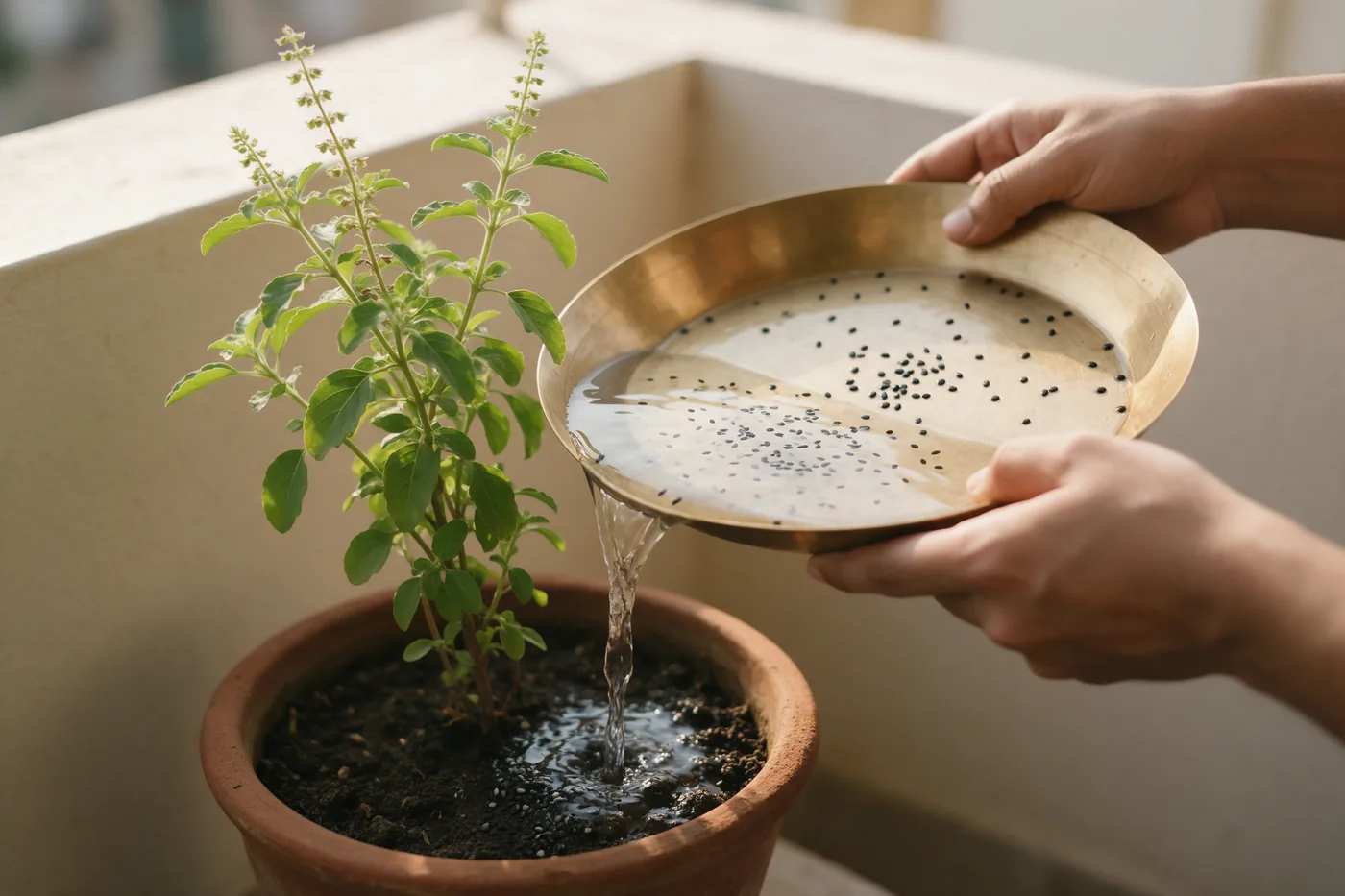
Offered water should be poured onto soil, at the base of a plant, or into moving water, rather than down a drain or sink.
Tarpan Mantras You Can Chant
The exact wording of the pitru tarpan mantra varies by regional and family tradition — Smarta, Vaishnava, Bengali and Tamil households each follow slightly different conventions. The versions below are widely used and safe starting points, but if your family follows a specific tradition, that version takes precedence over any general guide.
The simplest option, suitable if you are new to this or short on time:
Om Pitrubhyo Namah
Salutations to the ancestors.
For a general offering to all ancestors, known and unknown:
Om Sarve Pitarah Swadha, Tarpayami Namah
I offer this water to all ancestors, with reverence.
For a named ancestor, once you know their name and gotra, the traditional structure follows this pattern, shown here for a father:
[Gotra Name] Gotre, Asmat Pita [Father's Name], Tripyatam Idam Tilodakam, Tasmai Swadha Namah — repeated three times
In the [gotra] lineage, may my father [name] be satisfied by this offering of sesame-water, salutations.
The same structure is adapted for mother, grandfather and grandmother by substituting the relationship term and the name. A family pandit can confirm the exact gotra-specific wording for your lineage if you want the fully personalised version.
To conclude, the Pitru Gayatri mantra:
Om Pitru Ganaya Vidmahe, Jagat Dharine Dhimahi, Tanno Pitro Prachodayat
We meditate on the assembly of ancestors who sustain this world. May the ancestors inspire and guide us.
Can't Perform the Ritual Yourself?
Tarpan is the one part of this tradition most people can manage alone. Pind Daan is a different matter. Its vidhi is more complex, it is traditionally performed at a specific sacred site such as Gaya, and it is generally not recommended as a home ritual — which is why most families engage a pandit for this part even if they handle Tarpan themselves.
If you would like it done correctly, Ekishwar's Pitru Tarpan at the Somnath Jyotirlinga Teerth offers til tarpan, and the Kashi Kund Tripindi Shraddh at Pishach Mochan Kund in Varanasi covers the full Shradh, each performed by a qualified pandit on your behalf.
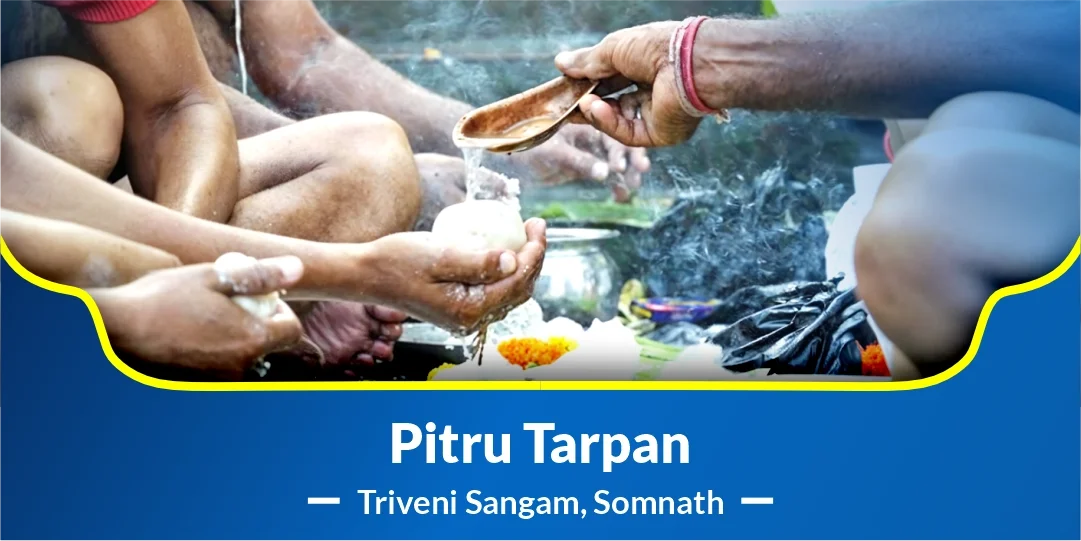 Til tarpan, done properlyPitru TarpanPitru Tarpan with til and water at the Somnath Jyotirlinga Teerth, Prabhas Patan.Shri Somnath Jyotirlinga Teerth, Prabhas PatanBook this puja
Whichever you choose, you will receive a recording of the ritual, so distance is never a reason to leave it undone.
Have Tarpan done at the ghat
Pitru TarpanSomnath · til tarpan Kashi Kund Tripindi Shraddh Purvaj Rin Shanti AnushthanVaranasi · Tripindi Shraddh
 Amavasya-Purnima Pind Daan - Purvaj Kripa VisheshRishikesh · Pind Daan on the Ganga
Pujas for you
Swipe · 3 pujasFrequently asked questions
- What is the correct tarpan vidhi at home?
- Bathe, wear clean clothes, sit facing south, take a short sankalp with your name and gotra, then offer water mixed with black sesame seeds through the gap between your thumb and the base of your index finger, three times for each ancestor, while chanting the tarpan mantra. Close with a general offering for all ancestors and pour the remaining water onto soil or a plant.
- What samagri is needed for Tarpan?
- Black sesame seeds (til) and clean water are the non-negotiable minimum. A copper or brass lota, kusha grass, a wide plate to receive the water, white rice or barley, white flowers, a ghee lamp and incense all enhance the ritual but are not essential.
- Which mantra is chanted during Tarpan?
- "Om Pitrubhyo Namah" is the simplest and is enough if you are new to this. For a general offering use "Om Sarve Pitarah Swadha, Tarpayami Namah", and close with the Pitru Gayatri. For a named ancestor the mantra carries their name and your gotra.
- Which direction should you face while performing Tarpan?
- South, which is traditionally the direction of the ancestors. The Deva and Rishi portions that precede the Pitru offering in the full Vedic sequence face east and north respectively, but the ancestor-specific portion is always done facing south.
- Can Tarpan be done without knowing your gotra or your ancestors' names?
- Yes. Tradition holds that a sincere offering made in general remembrance is still accepted, so a general sankalp for ancestors known and unknown, on both paternal and maternal sides, is valid even without full names or lineage.
- Can a daughter perform Pitru Tarpan?
- Traditionally a son is considered the primary performer for the paternal lineage, generally once his own father has passed away. Daughters and other family members performing Tarpan, particularly where there is no son or simply out of devotion, is increasingly accepted across many communities today.
- Can Pind Daan be done at home like Tarpan?
- Generally not. Pind Daan has a more complex vidhi and is traditionally performed at a specific sacred site such as Gaya, which is why most families engage a pandit for it even when they handle Tarpan themselves at home.
- Tarpan vidhi
- Tarpan mantra
- Pitru tarpan mantra
- Shraddha karma
- Pind Daan vidhi
- Shradh puja
- Pitru Paksha
Read next
All guides → Pitru PakshaPitru Dosha Remedies: 11 Proven Ways to Remove Pitra DoshKnowing you have Pitru Dosha is only half the answer. Eleven remedies, from a one-minute daily ritual to the pujas that need a priest and a sacred site.30 Sept 2026 · 5 min read
 Pitru PakshaWhat Is Pitru Dosha? Signs, Types, Effects, and How to Remove ItThe same problems keep circling back — marriage, money, health. Sometimes the cause is older than your choices. The 14 types of Pitra Dosh, and what each does.30 Sept 2026 · 7 min read
 Pitru PakshaPitru Paksha 2026 Dates: Shradh Start Date, End Date and Full Tithi ListSixteen tithis, fifteen days, one window each year to settle what your lineage still carries. Every Shradh 2026 date, and what to actually do on each.25 Sept 2026 · 7 min read